Cleveland Museum of Art
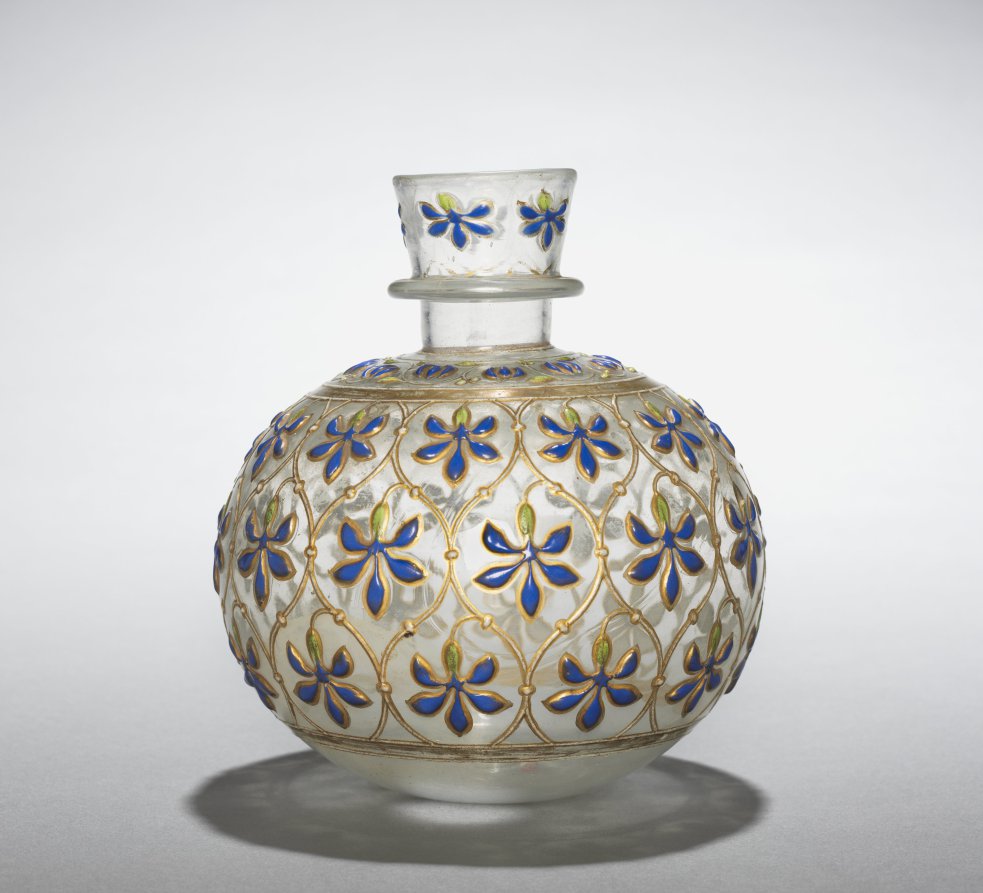
Hookah Base
- Date
- early 1700s
- Medium
- Glass with colored enamel and gilding
- Culture
- India, Mughal Dynasty (1526-1756)
- Department
- Indian and Southeast Asian Art
- Institution
- Cleveland Museum of Art
- Object ID
- 144662
From the Cleveland Museum of Art record
Smoking tobacco was introduced to the Mughal court from Iran in the very early 1600s and soon became popular. This base formed part of a hookah, or water pipe, which consisted of a base that held water—sometimes perfumed with herbs or fresh fruit—a detachable bowl to hold tobacco, and a long tube. Early hookahs used existing vessels for bases, including coconut shells. By the late 1600s or early 1700s, richly decorated pieces like this were produced. The jewel-like decoration of blue and green blossoms evokes a garden in which a smoker might have sat. Turquoise five-petaled flowers hang from lime green pedicels.
The authoritative record is held by Cleveland Museum of Art. LinkedCulture surfaces this object and its connections; it does not alter institutional metadata.
Get printable QR codesHide QR codes
Open QR codes for this object page and the museum record. They stay collapsed until needed.
Provenance & credit
As published by the source institution. Coverage varies — not every institution's open-data feed includes ownership history.
- Credit line
- The Norweb Collection
- Provenance
- ?–1969: Mrs. R. Henry [Emery May Holden] Norweb [1895–1984], Cleveland, OH, given to the Cleveland Museum of Art | 1969–: The Cleveland Museum of Art, Cleveland, OH
Related across collections
Semantically similar works from Cleveland Museum of Art and other institutions.