Getty Museum
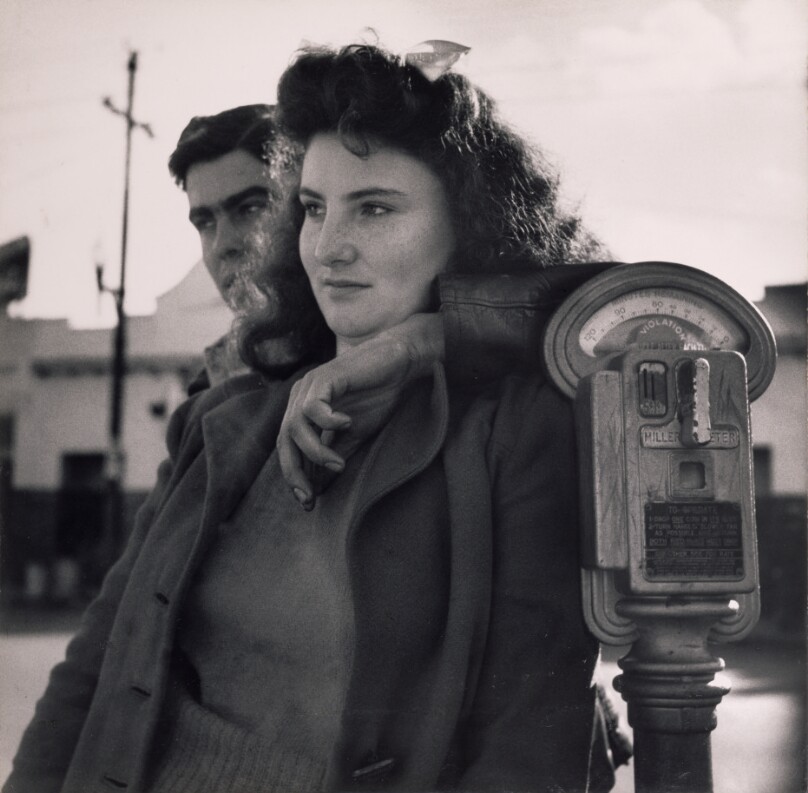
Lovers, Richmond, California
Creator
Dorothea LangeAmerican Photographer · 1895–1965
All works by this person →Born Dorothea Nutzhorn in Hoboken, New Jersey, to first-generation German Americans, Dorothea Lange was stricken at age seven with polio, which left her right leg and foot disfigured. Her father abandoned the family when she was twelve. After high school, she apprenticed with portrait photographer Arnold Genthe in Manhattan and studied with Clarence H. White at Columbia University’s Teacher’s Coll
More on Getty ULAN- Date
- 1942
- Medium
- Gelatin silver print
- Culture
- American
- Department
- Photographs
- Institution
- Getty Museum
- Object ID
- 52349b56-ef1a-4e8a-83bb-b5b2a35af0fb
From the Getty Museum record
> Charles Wollenberg's 1995 book *Photographing the Second Gold Rush: Dorothea Lange and the East Bay at War, 1941-1945* captions a wider view of this scene, which includes a Coca-Cola billboard and a car at left, as follows: "New economic opportunities and wartime cultural changes transformed this young couple's world. MacDonald Avenue, Richmond." This was no doubt true, but probably much more so for the young woman than for her boyfriend, whose face is barely see but whose arm encircles her neck. It is likely that both were newly employed at the Kaiser Shipyards but unlikely that they held the same jobs or belonged to the same union. > > Heavy industry was one of the last modern arenas of male exclusivity, and the shipyard men wanted to keep it that way. To this end, women were kept in the lowest-paying jobs, excluded from most of the unions, and made to adhere to "rules of rude and graceless dress," as Katherine Archibald (*Wartime Shipyard : A Study in Social Disunity*, 1947) called the camouflaging requirements that included covering one's hair, wearing overalls or pants, and doing without makeup on nail polish. Although "Rosie the Riveter," the superwoman of the assembly line, was partly myth, she was a pioneer, especially in the wartime shipyard. Rather than recognizing this as progress, her male colleagues reacted with resentment and calls for women to return to the home. But these new welders, pipe fitters, and, occasionally, electricians wanted to learn a trade and, at the same time, maintain evidence of their femininity. This they attempted to do after their shift, and in spite of the workplace tension between the sexes. The prominent parking meter on the right in this image may refer to round-the-clock shifts that now governed the workers' lives. Judith Keller, *Dorothea Lange,* In Focus: Photographs from the J. Paul Getty Museum (Los Angeles: J. Paul Getty Museum, 2002), p. 56. © 2002 J. Paul Getty Trust.
The authoritative record is held by Getty Museum. LinkedCulture surfaces this object and its connections; it does not alter institutional metadata.
Get printable QR codesHide QR codes
Open QR codes for this object page and the museum record. They stay collapsed until needed.
Related across collections
Semantically similar works from Getty Museum and other institutions.