
Minneapolis Institute of Art
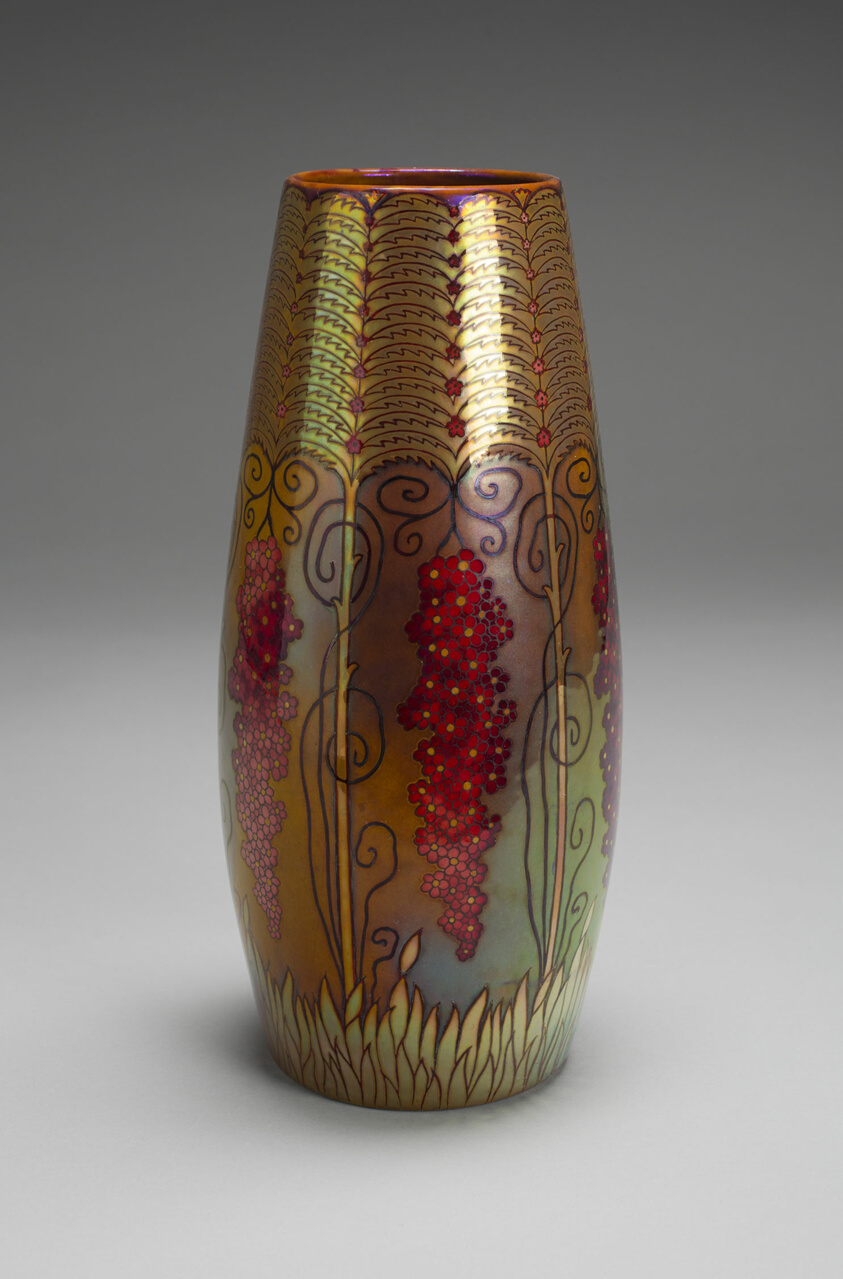
Grand vase
Zsolnay Art Pottery
- Date
- 1899
- Medium
- Earthenware with iridescent metallic-lustre 'eosin' glaze
- Department
- European Art
- Institution
- Minneapolis Institute of Art
In central Europe-Austria-Hungary and what are now the Czech and Slovak states-Art Nouveau ceramic production was generally far more commercial than elsewhere. With the marked exception of certain Viennese workshops, design was geared more to popular taste. In Pécs, Hungary, Vilmós Zsolnay and his son Miklos created a range of brightly-colored lusterware at the family firm of Zsolnay founded in 1862. Around 1899, a factory chemist, Vinsce Wartha, developed the Eosin glase for which the firm became world famous. Though the designer remains unknown, this grand vase is one of the finest examples in the entire Zsolnay production. Earthenware with the celebrated iridescent metallic-lustre glaze, this piece was extremely important to the firm, having been featured in the Hungarian display at the 1900 Paris Exposition Universelle (the same year the company swelled to 1000 employees). The wilted tulip blossoms conveyed the sentiments of Symbolism, a parallel art movement in which ideas and emotional experiences could be suggested by equivalents in color and design.
The authoritative record is held by Minneapolis Institute of Art. LinkedCulture surfaces this object and its connections; it does not alter institutional metadata.
Related across collections
Semantically similar works from Minneapolis Institute of Art and other institutions.
Vase
Art Institute of Chicago

Vase
Minneapolis Institute of Art

Vase
Minneapolis Institute of Art

Covered Vase
Minneapolis Institute of Art

Vase
Minneapolis Institute of Art

Flower vase
Minneapolis Institute of Art

Vase, one of a pair
Minneapolis Institute of Art

Vase
Minneapolis Institute of Art

Vase
Minneapolis Institute of Art
Vase with Cover
Art Institute of Chicago
Vase (Vase étrusque à rouleau)
Art Institute of Chicago
Vase (One of a Pair)
Art Institute of Chicago