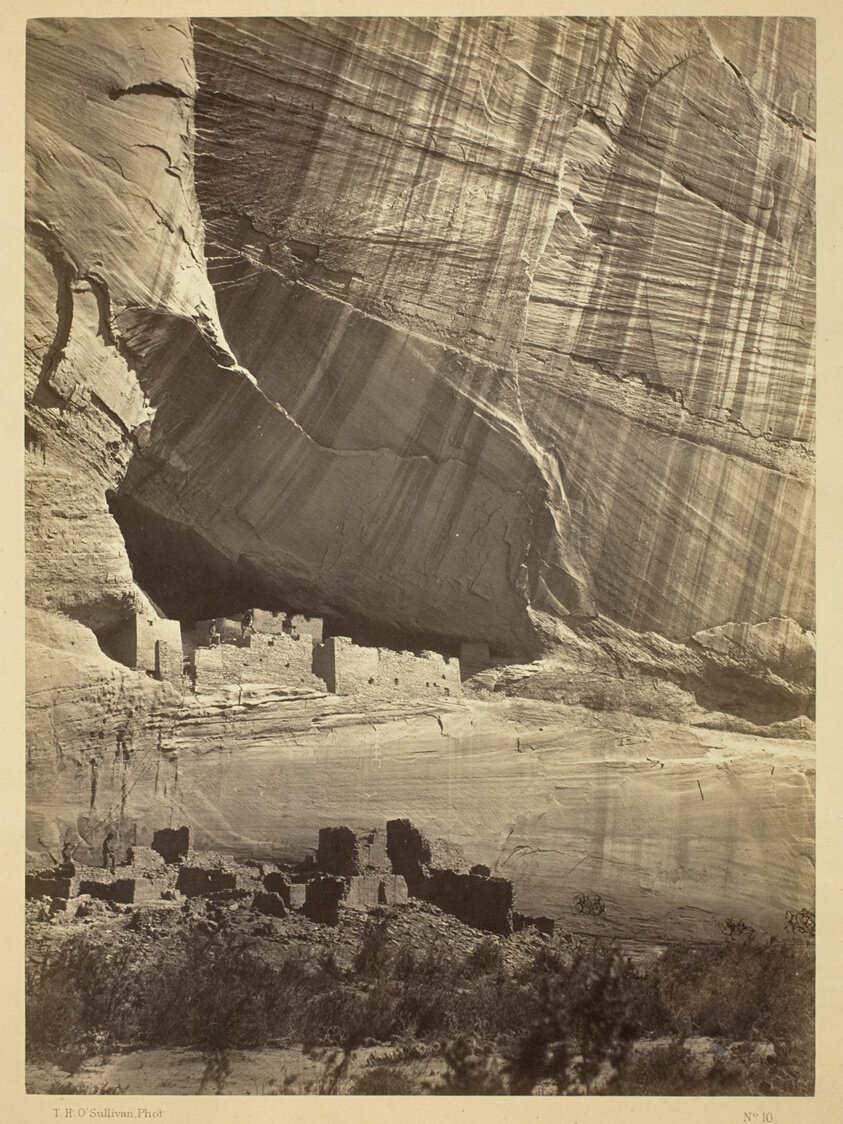
Ancient Ruins in the Cañon de Chelle, N.M. In a niche 50 feet above present Cañon bed.

Art Institute of Chicago

Ancient Ruins in the Cañon de Chelle, N.M. In a niche 50 feet above present Cañon bed.

Timothy O'Sullivan

Date
1873
Medium
Albumen print
Culture
United States
Department
Photography and Media
Institution
Art Institute of Chicago

In 1871 Timothy O’Sullivan, an experienced outdoor photographer, was recruited to contribute to a survey of the American Southwest with goals of assessing the native population, selecting sites for future military installations and railways, identifying mineral and other resources, and clarifying the border with Mexico. Working with cartographers and natural scientists, O’Sullivan documented lands unexplored by non-Native Americans, providing highly detailed photographs such as this image of Canyon de Chelly in northwestern northeastern Arizona, which had been continuously inhabited by the Anasazi and Navajo for nearly 5,000 years. Here O’Sullivan depicted the White House ruins, the striations of the canyon wall, and two small figures below, conveying the site’s monumental character. Although O’Sullivan’s famously sparse views are considered by some as forerunners to the modernist aesthetic of the early 20th century, such documents were likely intended only to imitate the graphic simplicity of maps and charts.

The authoritative record is held by Art Institute of Chicago. LinkedCulture surfaces this object and its connections; it does not alter institutional metadata.

Linked open data

Authority identifiers that link this record into the wider web of cultural data — stable references you can follow to the source.

Object type
AAT300046300

Related across collections

Semantically similar works from Art Institute of Chicago and other institutions.

Ruins in Cañon de Chelle, N. M., in a cavity in the wall, 60 feet above present bed of Cañon. Height of walls about 700 feet. The present race of Indians know nothing of the age of these buildings of who occupied them, No. 21 from the series "Geographical Explorations and Surveys West of the 100th Meridian"

Ruins in Cañon de Chelle, N. M., in a cavity in the wall, 60 feet above present bed of Cañon. Height of walls about 700 feet. The present race of Indians know nothing of the age of these buildings of who occupied them, No. 21 from the series "Geographical Explorations and Surveys West of the 100th Meridian"

Art Institute of Chicago

Central portion of Canñon de Chelle, New Mexico. This Canñon is one of the most remarkable in the west, and is noted for its beauty. The walls are of Red Sand-stone, nearly perpendicular, and at this point are 1.200 feet in height, No. 24 from the series "Geographical Explorations and Surveys West of the 100th Meridian"

Central portion of Canñon de Chelle, New Mexico. This Canñon is one of the most remarkable in the west, and is noted for its beauty. The walls are of Red Sand-stone, nearly perpendicular, and at this point are 1.200 feet in height, No. 24 from the series "Geographical Explorations and Surveys West of the 100th Meridian"

Art Institute of Chicago

Characteristic ruin, of the Pueblo San Juan, New Mexico, on the north bank of the San Juan River, about 15 miles west of the mouth of Cañon Largo. The present race of Indians know nothing of when or by whom these buildings were constructed. The ruin is about 350 feet square, and built of natural stone, joined together by a mud cement, No. 43 from the series "Geographical Explorations and Surveys West of the 100th Meridian"

Characteristic ruin, of the Pueblo San Juan, New Mexico, on the north bank of the San Juan River, about 15 miles west of the mouth of Cañon Largo. The present race of Indians know nothing of when or by whom these buildings were constructed. The ruin is about 350 feet square, and built of natural stone, joined together by a mud cement, No. 43 from the series "Geographical Explorations and Surveys West of the 100th Meridian"

Art Institute of Chicago

Circle Walls, Cañon de Chelle. Here the Cañon bends from an easterly direction nearly due north, the walls maintaining a perpendicular height of about 1.200 feet, No. 22 from the series "Geographical Explorations and Surveys West of the 100th Meridian"

Circle Walls, Cañon de Chelle. Here the Cañon bends from an easterly direction nearly due north, the walls maintaining a perpendicular height of about 1.200 feet, No. 22 from the series "Geographical Explorations and Surveys West of the 100th Meridian"

Art Institute of Chicago

Camp Beauty, Canñon de Chelle; walls 1.200 feet high, width of Cañon at this point about one fourth of a mile. This view shows the perpendicular effect wrought by the action of floods. The Artist of the Expedition, Mr. Wyant, of New York, made a study of this scene with the intention to paint it as a characteristic Canon view, No. 25 from the series "Geographical Explorations and Surveys West of the 100th Meridian"

Camp Beauty, Canñon de Chelle; walls 1.200 feet high, width of Cañon at this point about one fourth of a mile. This view shows the perpendicular effect wrought by the action of floods. The Artist of the Expedition, Mr. Wyant, of New York, made a study of this scene with the intention to paint it as a characteristic Canon view, No. 25 from the series "Geographical Explorations and Surveys West of the 100th Meridian"

Art Institute of Chicago

Explorers Column, Cañon de Chelle, Arizona. This shaft is the work of nature, and is about 900 feet in height; base about 70 by 110 feet. It stands near the center of the Cañon, and it is almost impossible to believe that it is not the work of human hands, No. 23 from the series "Geographical Explorations and Surveys West of the 100th Meridian"

Explorers Column, Cañon de Chelle, Arizona. This shaft is the work of nature, and is about 900 feet in height; base about 70 by 110 feet. It stands near the center of the Cañon, and it is almost impossible to believe that it is not the work of human hands, No. 23 from the series "Geographical Explorations and Surveys West of the 100th Meridian"

Art Institute of Chicago

Cañon de Chelle, Walls of the Grand Cañon, about 1200 feet in height

Cañon de Chelle, Walls of the Grand Cañon, about 1200 feet in height

Art Institute of Chicago

Ruins of Cliff Dwellings, Cañon de Chelly, Arizona

Ruins of Cliff Dwellings, Cañon de Chelly, Arizona

Cleveland Museum of Art

Navajo Indian Squaw, and Child, at their home, in Cañon de Chelle, No. 27 from the series "Geographical Explorations and Surveys West of the 100th Meridian"

Navajo Indian Squaw, and Child, at their home, in Cañon de Chelle, No. 27 from the series "Geographical Explorations and Surveys West of the 100th Meridian"

Art Institute of Chicago

Cañon, Valley of the Conejos River, looking south from vicinity of "Lost Lakes", No. 36 from the series "Geographical Explorations and Surveys West of the 100th Meridian"

Cañon, Valley of the Conejos River, looking south from vicinity of "Lost Lakes", No. 36 from the series "Geographical Explorations and Surveys West of the 100th Meridian"

Art Institute of Chicago

Historic Spanish Record of the Conquest, South Side of Inscription Rock, N.M.

Historic Spanish Record of the Conquest, South Side of Inscription Rock, N.M.

Art Institute of Chicago

Mono Lake, Volcano, 13,000 Feet

Mono Lake, Volcano, 13,000 Feet

Art Institute of Chicago