Art Institute of Chicago
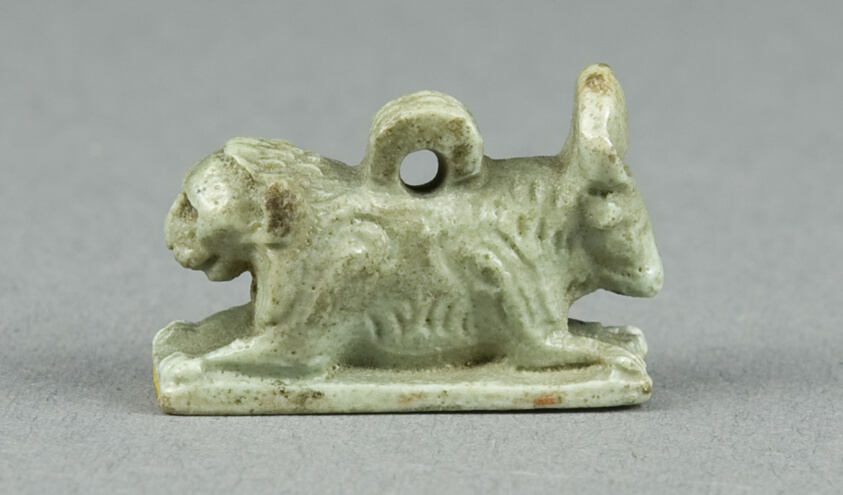
Amulet of a Double Animal: Lion and Bull
EgyptianLinkedCulture matchlcp-b3f2759025d0
- Date
- Late Period, Dynasty 26 (664–525 BCE)
- Medium
- Faience
- Culture
- Egypt
- Department
- Arts of Africa
- Institution
- Art Institute of Chicago
- Object ID
- 141003
From the Art Institute of Chicago record
Ancient Egyptians had several terms for small objects like this, which we call “amulets.” Worn by the living and the dead, these charms were meant to bring protection, health, and good luck, ensuring the bearer’s well-being in both life and the afterlife. This amulet depicts the foreparts of both a lion and a bull, joined together at the back. It resembles another amulet type that shows conjoined lions, a representation of the god Aker, who was associated with the western and eastern horizons in the underworld. The identities of the figures on double-bull, double-ram, or lion-and-bull amulets like this one remain more elusive. To an ancient Egyptian audience, the placement of the suspension loop in the center of the two animals would have evoked the hieroglyph for “horizon,” which represents the sun between two hills. Viewed in profile, the loop resembles the sun rising or setting against the horizon of the animals’ backs and may suggest that the amulet’s significance is tied to the solar cycle. Ancient Egyptians hoped that, just as the sun was reborn each day, they would experience their own rebirth into the afterlife.
The authoritative record is held by Art Institute of Chicago. LinkedCulture surfaces this object and its connections; it does not alter institutional metadata.
Get printable QR codesHide QR codes
Open QR codes for this object page and the museum record. They stay collapsed until needed.
Provenance & credit
As published by the source institution. Coverage varies — not every institution's open-data feed includes ownership history.
- Credit line
- Gift of Henry H. Getty, Charles L. Hutchinson, Robert H. Fleming, and Norman W. Harris
- Provenance
- The Art Institute of Chicago, acquired in 1894; purchased with funds provided by Henry H. Getty, Charles L. Hutchinson, Robert H. Fleming, and Norman W. Harris.
Linked open data
Authority identifiers that link this record into the wider web of cultural data — stable references you can follow to the source.
- Object type
- AAT300209261
Related across collections
Semantically similar works from Art Institute of Chicago and other institutions.