Art Institute of Chicago
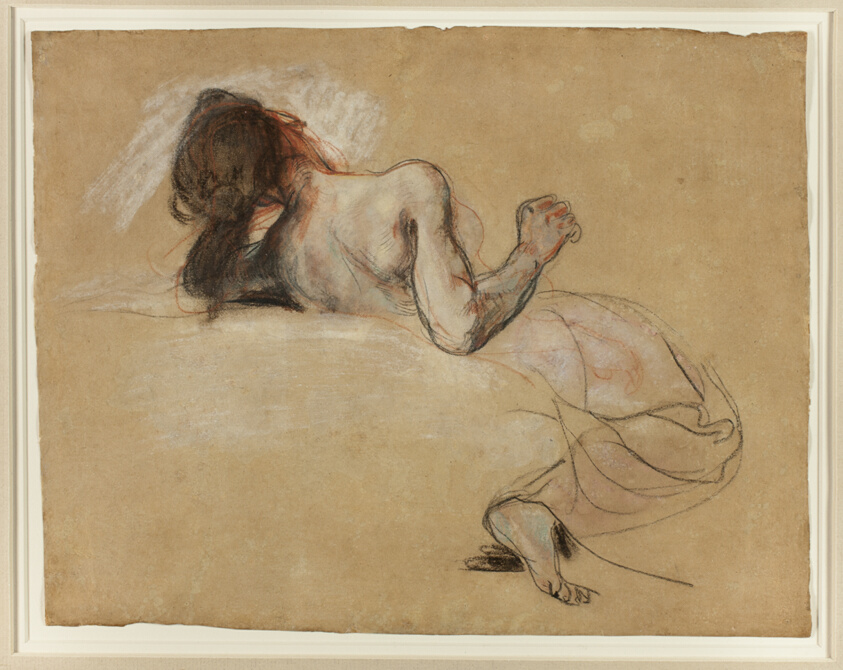
Crouching Woman
Eugène DelacroixLinkedCulture matchlcp-ff01cec55b2b
- Date
- 1827
- Medium
- Black and red chalk, with pastel, heightened with white chalk, over wash, on tan wove paper
- Culture
- France
- Department
- Prints and Drawings
- Institution
- Art Institute of Chicago
- Object ID
- 76779
From the Art Institute of Chicago record
Crouching Woman is one of five pastel studies for Eugène Delacroix’s monumental painting The Death of Sardanapalus (1827; Musée du Louvre, Paris), which helped establish his reputation as the leader of the French Romantic movement. Of the few pastels that Delacroix produced, this is the only group that can be related to a single painting. Inspired by an 1821 play by the English Romantic poet Lord Byron, the canvas dramatically depicts the last king of the Assyrians. Reclining on his bed moments before his own suicide, the king gazes passively at his wives, concubines, and livestock as they are slain by his order to prevent their slaughter by the enemy army that has just defeated them. In this expressive image of one of the concubines, Delacroix convincingly captured the horror of the moment. With a sure, sweeping line, he described the rhythmic, taut posture of a figure recoiling from a blow or the stab of a knife. Although this powerful figure is significantly truncated in the final painting, the pastel provides insight into Delacroix’s creative process, and its sensual drama is representative of the Romantic period.
The authoritative record is held by Art Institute of Chicago. LinkedCulture surfaces this object and its connections; it does not alter institutional metadata.
Get printable QR codesHide QR codes
Open QR codes for this object page and the museum record. They stay collapsed until needed.
Provenance & credit
As published by the source institution. Coverage varies — not every institution's open-data feed includes ownership history.
- Credit line
- Through prior bequest of Mr. and Mrs. Martin A. Ryerson Collection
- Provenance
- Bequeathed by the artist to Charles Laurent Marechal (called Marechal de Metz) (died 1887); by descent to his son, Bar-le-Duc; sold to M. Landry. Victor Decock, by 1936 [Brussels 1936]; sold, Galerie Charpentier, Paris, May 12, 1948, Decock sale, lot 2. Private Collector, Paris; sold, Francis Briest, Paris, Apr. 10, 1989, lot 1. Sold by Brandt Dayton, New York, to the Art Institute of Chicago, 1990.
Linked open data
Authority identifiers that link this record into the wider web of cultural data — stable references you can follow to the source.
- Object type
- AAT300033973
Related across collections
Semantically similar works from Art Institute of Chicago and other institutions.