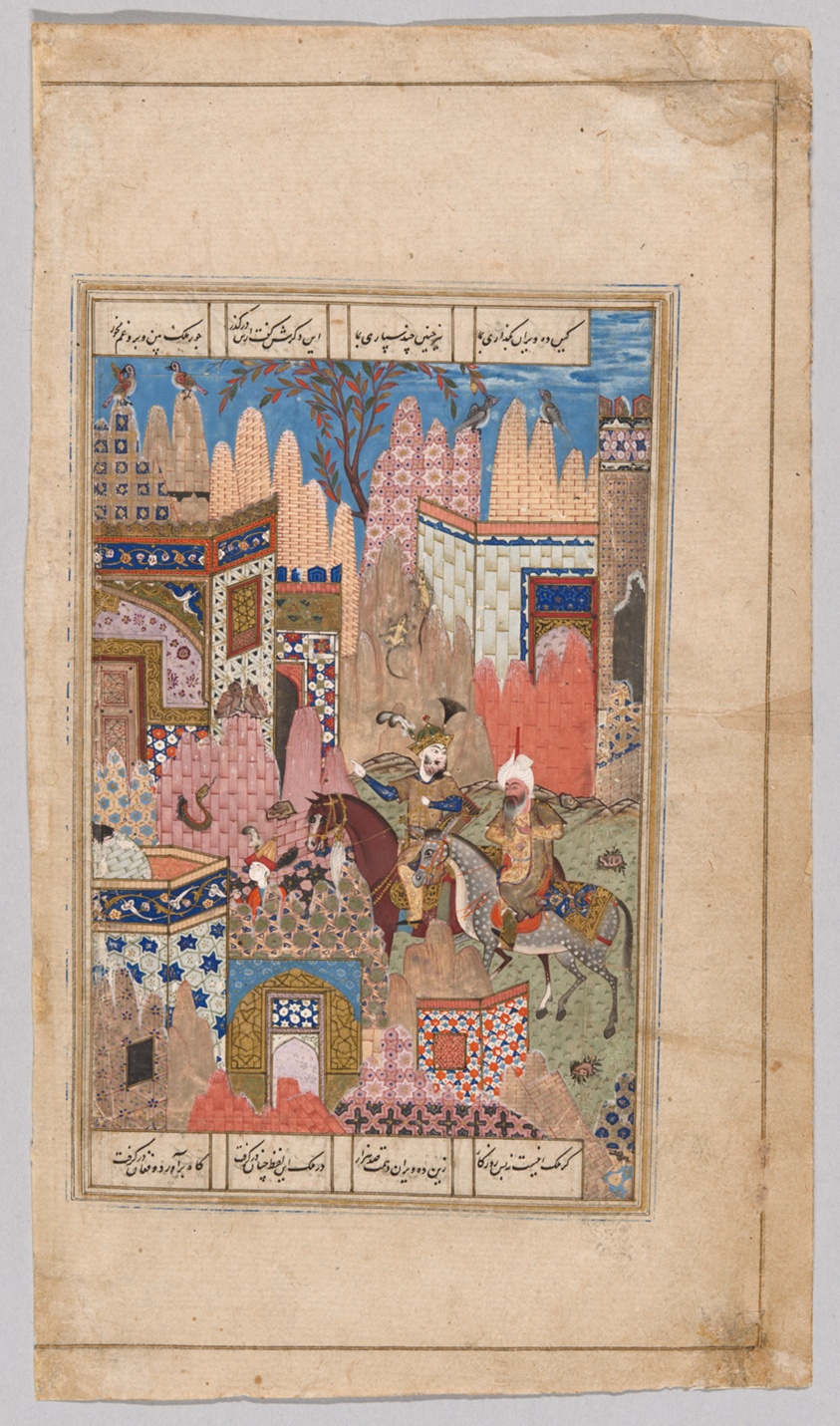
King Anushirwan and the Owls, from the Khamsa of Nizami

Art Institute of Chicago

King Anushirwan and the Owls, from the Khamsa of Nizami

Iran

Date
Safavid dynasty (1501–1722), c.1535
Medium
Ink, opaque watercolor, and gold on paper
Culture
Iran
Department
Arts of Asia
Institution
Art Institute of Chicago

Writing in the late twelfth and early thirteenth centuries, the Persian poet Nizami achieved fame with five epic poems known collectively as the Khamsa (Quintet). The most popular works in the quintet are the three romantic epics. The least popular and most difficult is the opening book, the Makhzan al-Asrar (Treasury of Mysteries). This particular text, an enigmatic pseudomystical poem, deals with issues of governance and universal justice presented as a series of moralizing discourses. The story of the great Sasanian king Anushirwan and the owls, shown here, is one of the most frequently illustrated episodes in the Makhzan al-Asrar. The monarch (reigned 531–79) and his advisor, on horseback, have become separated from their hunting party and approach a deserted village that is falling into ruin. Working in the painting style of the imperial Sasanian court, the artist provided details including crumbling candy-colored tile work, melting corncob-shaped walls, a snake emerging from a crack in a wall, and a pair of lizards scrambling on the rocks. The king hears two owls hooting— they sit on a disintegrating wall just to the left of center—and wonders what they are saying. The advisor explains that one of the birds is giving his daughter away to the other and asked for an appropriate bride-price—for example, the ruined village and one or two others. The other owl replies that if the present king’s policies didn’t change, he could give his father-in-law a hundred thousand abandoned villages. Anushirwan was an accomplished warrior, but according to this anecdote, he was not just a ruler, and his people were suffering.

The authoritative record is held by Art Institute of Chicago. LinkedCulture surfaces this object and its connections; it does not alter institutional metadata.

Linked open data

Authority identifiers that link this record into the wider web of cultural data — stable references you can follow to the source.

Object type
AAT300033618

Related across collections

Semantically similar works from Art Institute of Chicago and other institutions.

Nushirwan Listens to the Owls (recto): Illustration and Text, Persian Verses, from a Manuscript of the Khamsa of Nizami, Makhzan al-Asrar [Treasure of Secrets]

Nushirwan Listens to the Owls (recto): Illustration and Text, Persian Verses, from a Manuscript of the Khamsa of Nizami, Makhzan al-Asrar [Treasure of Secrets]

Cleveland Museum of Art

Nushirwan Listens to the Owls (recto); the Story of Nushirwan and his Minister, "The Third Discourse on Diverse Events and Disorder in Life" (verso) from a Khamsa (Quintet) of Nizami (1141–1209)

Nushirwan Listens to the Owls (recto); the Story of Nushirwan and his Minister, "The Third Discourse on Diverse Events and Disorder in Life" (verso) from a Khamsa (Quintet) of Nizami (1141–1209)

Cleveland Museum of Art

The Story of Nushirwan and his Minister, "The Third Discourse on Diverse Events and Disorder in Life" from a  Khamsa (Quintet) of Nizami (1141–1209) (verso)

The Story of Nushirwan and his Minister, "The Third Discourse on Diverse Events and Disorder in Life" from a Khamsa (Quintet) of Nizami (1141–1209) (verso)

Cleveland Museum of Art

An Episode from the Story of the Sasanian King Khusrau and His Beloved Shirin, from a Khamsa (Quintet) of Nizami (1141–1209) (verso); Persian verses from a Haft Awrang (Seven Thrones) of Jami (d. 1492) (recto)

An Episode from the Story of the Sasanian King Khusrau and His Beloved Shirin, from a Khamsa (Quintet) of Nizami (1141–1209) (verso); Persian verses from a Haft Awrang (Seven Thrones) of Jami (d. 1492) (recto)

Cleveland Museum of Art

An Episode from the Story of the Sasanian King Khusrau and His Beloved Shirin, from a Khamsa (Quintet) of Nizami (1141–1209) (verso)

An Episode from the Story of the Sasanian King Khusrau and His Beloved Shirin, from a Khamsa (Quintet) of Nizami (1141–1209) (verso)

Cleveland Museum of Art

Persian Verses: The Fortieth Year of King Kisra Nushirwan's Reign and the Story of Buzurgmihr (recto); Portrait of Nushirwan the Just (verso) from a Shahnama (Book of Kings) of Firdausi (940–1019 or 1025)

Persian Verses: The Fortieth Year of King Kisra Nushirwan's Reign and the Story of Buzurgmihr (recto); Portrait of Nushirwan the Just (verso) from a Shahnama (Book of Kings) of Firdausi (940–1019 or 1025)

Cleveland Museum of Art

Khusrau Subduing a Lion

Khusrau Subduing a Lion

Minneapolis Institute of Art

Persian Verses: The Fortieth Year of King Kisra Nushirwan's Reign and the Story of Buzurgmihr (recto) from a Shahnama (Book of Kings) of Firdausi (940–1019 or 1025)

Persian Verses: The Fortieth Year of King Kisra Nushirwan's Reign and the Story of Buzurgmihr (recto) from a Shahnama (Book of Kings) of Firdausi (940–1019 or 1025)

Cleveland Museum of Art

A King Picnicking in the Mountains

A King Picnicking in the Mountains

Minneapolis Institute of Art

Portrait of Nushirwan the Just (verso) from a Shahnama (Book of Kings) of Firdausi (940–1019 or 1025)

Portrait of Nushirwan the Just (verso) from a Shahnama (Book of Kings) of Firdausi (940–1019 or 1025)

Cleveland Museum of Art

Bahram Gur Visits the Princess of India in the Black Pavilion (recto): Illustration and Text, Persian Verses, from a manuscript of the Khamsa of Nizami, Haft Paykar [Seven Portraits]

Bahram Gur Visits the Princess of India in the Black Pavilion (recto): Illustration and Text, Persian Verses, from a manuscript of the Khamsa of Nizami, Haft Paykar [Seven Portraits]

Cleveland Museum of Art

Bahram Visits the White Domed Pavilion on Friday, illustrated with text in Khamsa of Nizami (verso), from a Haft Paykar (Seven Portraits) of Nizami

Bahram Visits the White Domed Pavilion on Friday, illustrated with text in Khamsa of Nizami (verso), from a Haft Paykar (Seven Portraits) of Nizami

Cleveland Museum of Art