Cleveland Museum of Art
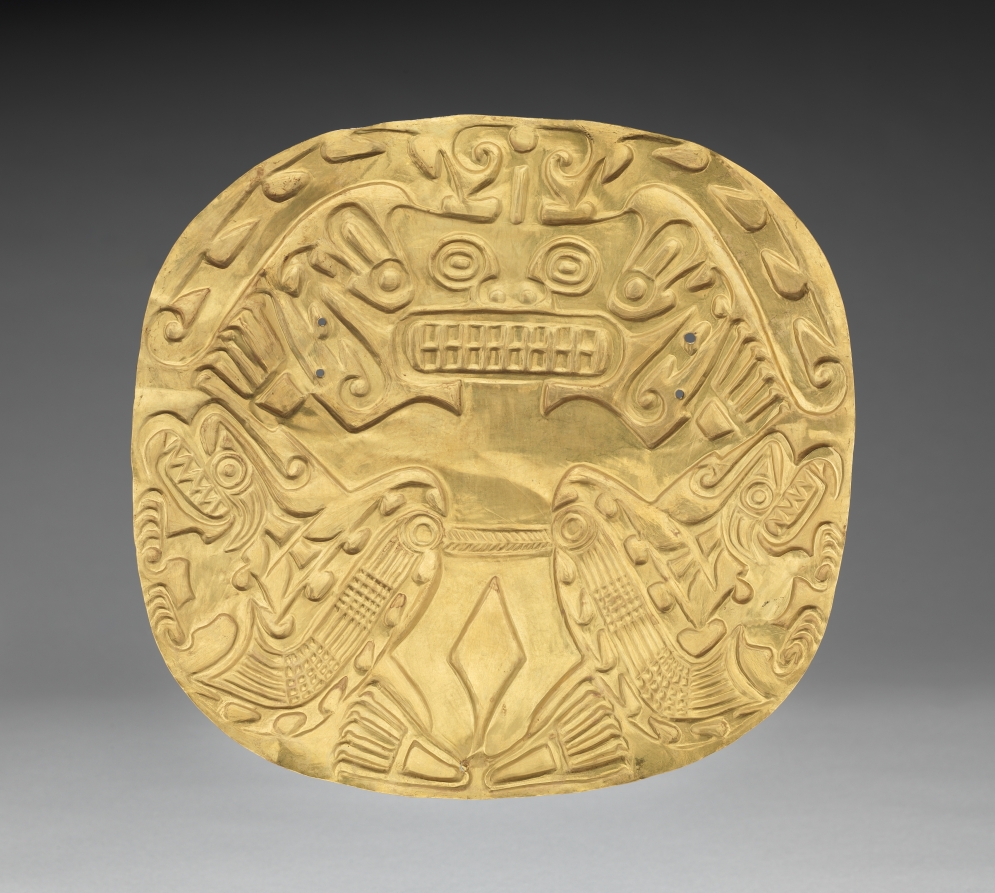
Pectoral (Chest Plaque)
- Date
- 400–900
- Medium
- gold alloy
- Culture
- Intermediate Region, Panama, Conte style, 5th-10th Century
- Department
- Art of the Americas
- Institution
- Cleveland Museum of Art
- Object ID
- 130039
From the Cleveland Museum of Art record
Harvard archaeologists excavated this and seven other ornaments from several burials at Sitio Conte, a cemetery famous for its lavish graves of powerful chieftains. The young man buried in Grave 26 was such a chief. His status was stunningly memorialized by 21 human companions and 475 objects, many of them personal ornaments made of gold, including a large chest plaque and a rod-shaped ear ornament. The creature on the chest plaque, found close to the chief’s body, has reptile claws and perhaps the head crest of an iguana. Its meaning is unknown but perhaps, as in later periods, reptilian imagery and the warm gleam of gold linked rulers with the sun’s creative force. Panning for gold was viewed as a sacred activity among the ancient inhabitants of Costa Rica and Panama.
The authoritative record is held by Cleveland Museum of Art. LinkedCulture surfaces this object and its connections; it does not alter institutional metadata.
Get printable QR codesHide QR codes
Open QR codes for this object page and the museum record. They stay collapsed until needed.
Provenance & credit
As published by the source institution. Coverage varies — not every institution's open-data feed includes ownership history.
- Credit line
- Gift of Mrs. R. Henry Norweb, Mrs. Albert S. Ingalls, with additions from the John L. Severance Fund
- Provenance
- 1930s-1952: Peabody Museum of Archaeology and Ethnology, Harvard University, Cambridge, Mass., to John Wise Ltd. Galleries, New York, NY | 1952: (John Wise Ltd. Galleries, New York, NY, 1952, sold to the Cleveland Museum of Art) | 1952-present: The Cleveland Museum of Art
Part of a LinkedCulture topic
 Pre-Columbian Body Adornment
These objects are personal ornaments and jewelry worn by ancient Mesoamerican and Andean cultures, including ear ornaments, nose ornaments, plaques, and costume decorations made from precious metals, stone, shell, and ce
359 objects from 4 institutions
Related across collections
Semantically similar works from Cleveland Museum of Art and other institutions.