Cleveland Museum of Art
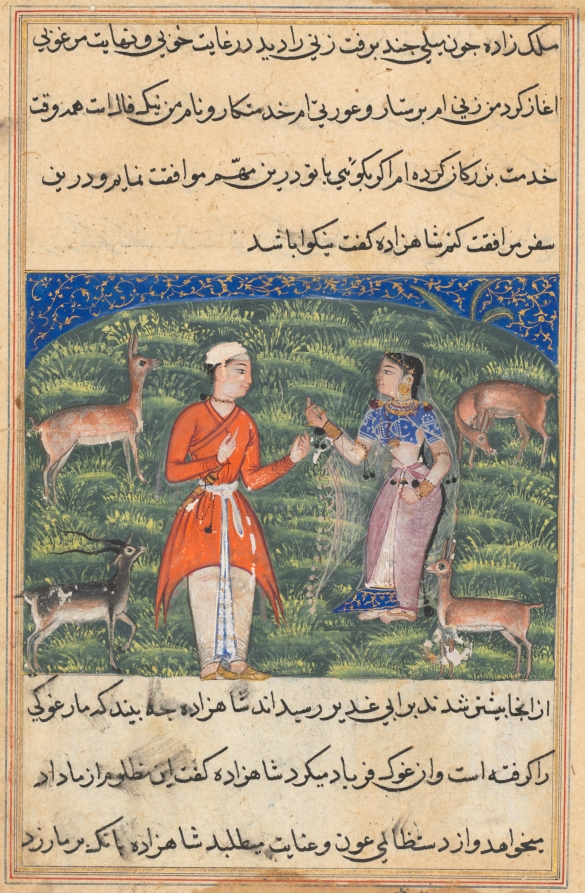
Nikfal, the fortune of the prince in the form of a woman, offers to accompany him, from a Tuti-nama (Tales of a Parrot): Eighteenth Night
- Date
- c. 1560
- Medium
- gum tempera, ink, and gold on paper
- Culture
- Mughal India, court of Akbar (reigned 1556–1605)
- Department
- Indian and Southeast Asian Art
- Institution
- Cleveland Museum of Art
- Object ID
- 137430
From the Cleveland Museum of Art record
The good fortune of the dervish that the prince purchased with his ring appeared to him in the form of a beautiful woman named Nikfal, meaning “Good Fortune.” The pair converse amiably in a grassy meadow full of deer under a lapis lazuli–blue sky with gold arabesque motifs. She wears Indian garments, while the prince is dressed as a Mughal in Central Asian garments. The story is said to take place in Zabulistan, in western Afghanistan. The animals in the background indicate that the scene is set in the wilderness.
The authoritative record is held by Cleveland Museum of Art. LinkedCulture surfaces this object and its connections; it does not alter institutional metadata.
Get printable QR codesHide QR codes
Open QR codes for this object page and the museum record. They stay collapsed until needed.
Provenance & credit
As published by the source institution. Coverage varies — not every institution's open-data feed includes ownership history.
- Credit line
- Gift of Mrs. A. Dean Perry
- Provenance
- ?–1959: Estate of Breckinridge Long [1881–1958], Bowie, MD | 1959–1962?: (Harry Burke Antiques, Philadelphia, PA) | 1959?–1962: (Bernard Brown Agency, Milwaukee, WI, sold to the Cleveland Museum of Art. Purchased with funds from Mrs. A. Dean [Helen Wade Greene] Perry) | 1962–: The Cleveland Museum of Art, Cleveland, OH
Related across collections
Semantically similar works from Cleveland Museum of Art and other institutions.