Cleveland Museum of Art
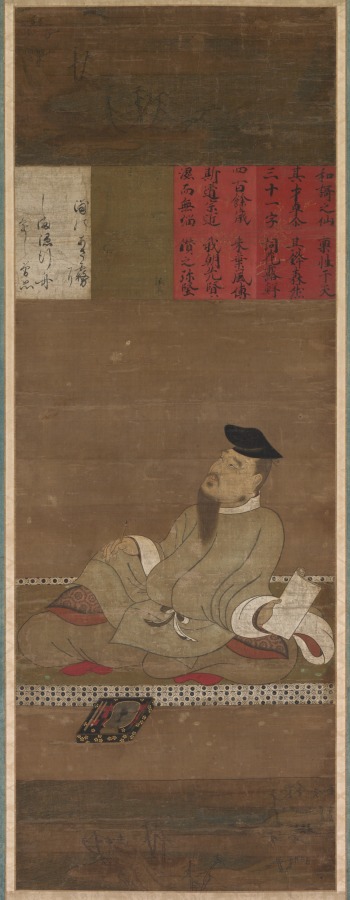
Kakinomoto no Hitomaro
- Date
- early 1300s
- Medium
- hanging scroll; ink and color on silk
- Culture
- Japan, Kamakura period (1185–1333)
- Department
- Japanese Art
- Institution
- Cleveland Museum of Art
- Object ID
- 149079
From the Cleveland Museum of Art record
Among Japan’s greatest poets, Kakinomoto no Hitomaro’s (c. 660–724) portrait was often displayed at poetry competitions. Here, he gazes up at a falling cherry blossom, his writing box before him, brush and paper in his hands. A short biography and one of his poems are inked on painted rectangles meant to look like decorated papers. The first part of the poem has been mostly lost, but from what remains, it is possible to recognize it as Dimly, dimly in the morning mist that lies over Akashi Bay, my longings follow with the ship that vanishes behind the distant isle. —Translated by Robert H. Bower and Earl Roy Miner The landscapes at the top and bottom of the painting depict Akashi Bay, with its famous pines along the shore, and a lone figure in a boat.
The authoritative record is held by Cleveland Museum of Art. LinkedCulture surfaces this object and its connections; it does not alter institutional metadata.
Get printable QR codesHide QR codes
Open QR codes for this object page and the museum record. They stay collapsed until needed.
Provenance & credit
As published by the source institution. Coverage varies — not every institution's open-data feed includes ownership history.
- Credit line
- Gift of Herbert F. Leisy in memory of his wife, Helen Stamp Leisy
- Provenance
- ?–1977: Mr. Herbert F. [1900–1977] and Mrs. Helen Stamp Leisy [1906–1975], Cleveland, OH, given to the Cleveland Museum of Art | 1977–: The Cleveland Museum of Art, Cleveland, OH
Related across collections
Semantically similar works from Cleveland Museum of Art and other institutions.