Cleveland Museum of Art
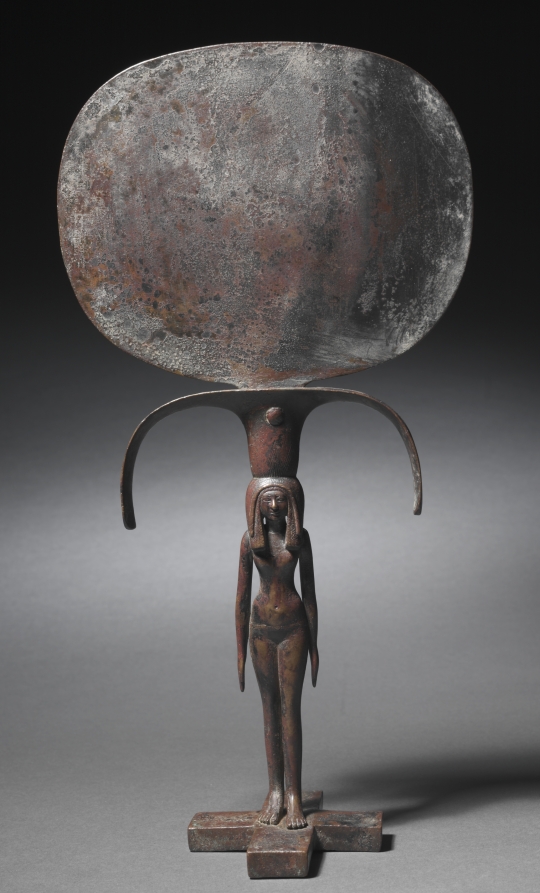
Caryatid Mirror
- Date
- c. 1540–1296 BCE
- Medium
- bronze with black copper inlay?
- Culture
- Egypt, New Kingdom (1540–1069 BCE), Dynasty 18
- Department
- Egyptian and Ancient Near Eastern Art
- Institution
- Cleveland Museum of Art
- Object ID
- 151352
From the Cleveland Museum of Art record
This superb mirror has an oval disk and a handle in the form of a nubile young girl, entirely naked except for her elaborately braided tripartite wig, broad collar, and a girdle of wallet beads. She stands on a cruciform base, with her left foot slightly advanced and her hands at her sides. On her head and supporting the disk is a papyrus umbel with flaring tips. Mirrors with handles in the form of naked young girls were the height of fashion in mid-Dynasty 18; numerous examples exist. This mirror is perhaps the finest of its kind. The cruciform base is unusual, if not unique. The iconography is understandable in relation to the goddess Hathor, the embodiment of love and beauty. A multifaceted goddess, she was equated with Aphrodite by the Greeks. The retinue of Hathor consisted precisely of such beauties, called nefrut in Egyptian, and the mirror itself, that reflection of beauty, appears to have had Hathorian connections from early times. When they were made, this mirror was polished to a brilliant shine; the marvelous colored patina it has since acquired is the result of being buried for years in the ground.
The authoritative record is held by Cleveland Museum of Art. LinkedCulture surfaces this object and its connections; it does not alter institutional metadata.
Get printable QR codesHide QR codes
Open QR codes for this object page and the museum record. They stay collapsed until needed.
Provenance & credit
As published by the source institution. Coverage varies — not every institution's open-data feed includes ownership history.
- Credit line
- Leonard C. Hanna Jr. Fund
- Provenance
- Claude Anet/Jean Schopfer (1868-1931), Paris, France | 1983-: The Cleveland Museum of Art, Cleveland, OH
Related across collections
Semantically similar works from Cleveland Museum of Art and other institutions.