Cleveland Museum of Art
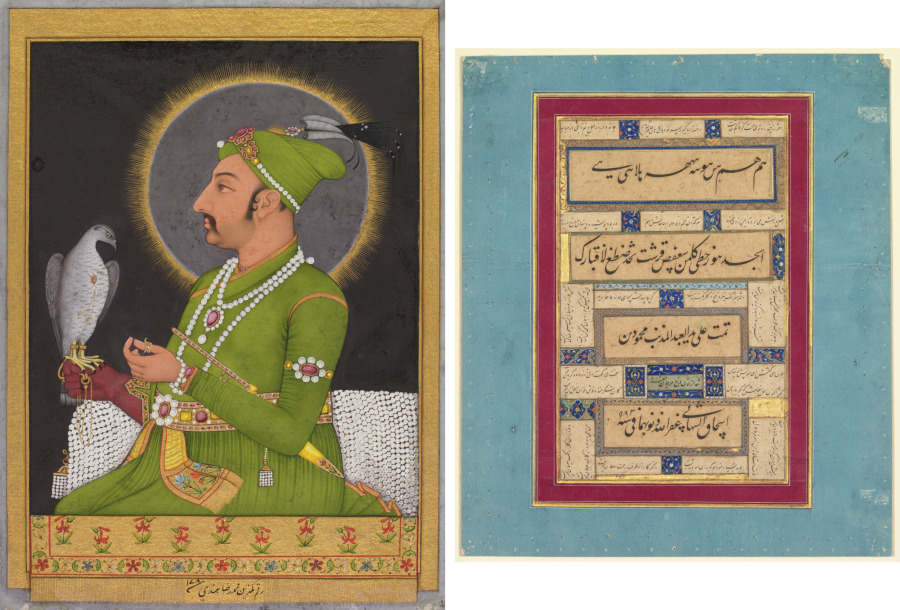
Posthumous portrait of the Mughal emperor Muhammad Shah (reigned 1719–1748) holding a falcon (recto); Calligraphy (verso)
Muhammad Rizavi HindiLinkedCulture matchlcp-b49d80e62beb
- Date
- 1764
- Medium
- Gum tempera, ink, and gold on paper
- Culture
- Mughal India, probably Uttar Pradesh, Lucknow
- Department
- Indian and Southeast Asian Art
- Institution
- Cleveland Museum of Art
- Object ID
- 170877
From the Cleveland Museum of Art record
Emperor Muhammad Shah, who reigned from 1719 to 1748, was known as “Rangila,” which means “the Colorful.” The innovative use of a black background sharply sets off the chartreuse green of his jama and the pearls of his adornments and bolster. On his left thumb he wears an archer’s ring, and a stabbing dagger is tucked into his bejeweled belt. Even his trained hunting falcon has a ruby necklace. In this formal posthumous portrait, the master artist conveys a heightened realism that emerges effortlessly from elegant contour lines and bold use of color. The work was part of an album of paintings collected in India before 1811 by a Scottish politician who worked for the British East India Company. The archer’s thumb ring is for drawing the bowstring. Perhaps he was left-handed.
The authoritative record is held by Cleveland Museum of Art. LinkedCulture surfaces this object and its connections; it does not alter institutional metadata.
Get printable QR codesHide QR codes
Open QR codes for this object page and the museum record. They stay collapsed until needed.
Provenance & credit
As published by the source institution. Coverage varies — not every institution's open-data feed includes ownership history.
- Credit line
- Gift in honor of Madeline Neves Clapp; Gift of Mrs. Henry White Cannon by exchange; Bequest of Louise T. Cooper; Leonard C. Hanna Jr. Fund; From the Catherine and Ralph Benkaim Collection
- Provenance
- before 1811–1849: Sir Charles Forbes, 7th Baronet [1773–1849], Bengal, London, and Scotland, by descent to his great-grandson, Colonel Sir John Forbes | ?–1962: Colonel Sir John Stewart Forbes [1901–1984], Baronet, DSO, DL, Allargue House, Strathdon, Aberdeenshire, Scotland, UK, consigned to Sotheby's London for sale | December 10, 1962: (Sotheby’s, London, Western and Oriental Manuscripts and Miniatures, 10 December 1962, lot 25, sold to Ralph Benkaim) | 1962–2013: Ralph Benkaim [1914–2001] and Catherine Glynn Benkaim [b. 1946], Beverly Hills, CA, sold to the Cleveland Museum of Art | 2013–: The Cleveland Museum of Art, Cleveland, OH
Related across collections
Semantically similar works from Cleveland Museum of Art and other institutions.