Cleveland Museum of Art
Hu-Shaped Vase with Handles
Seifū Yohei IVLinkedCulture matchlcp-8011e1c8592a
- Date
- 1914–46
- Medium
- Porcelain with molded and carved design and green glaze
- Culture
- Japan, Taishō period (1912–26) or Shōwa period (1926–89)
- Department
- Japanese Art
- Institution
- Cleveland Museum of Art
- Object ID
- 447760
What the image shows
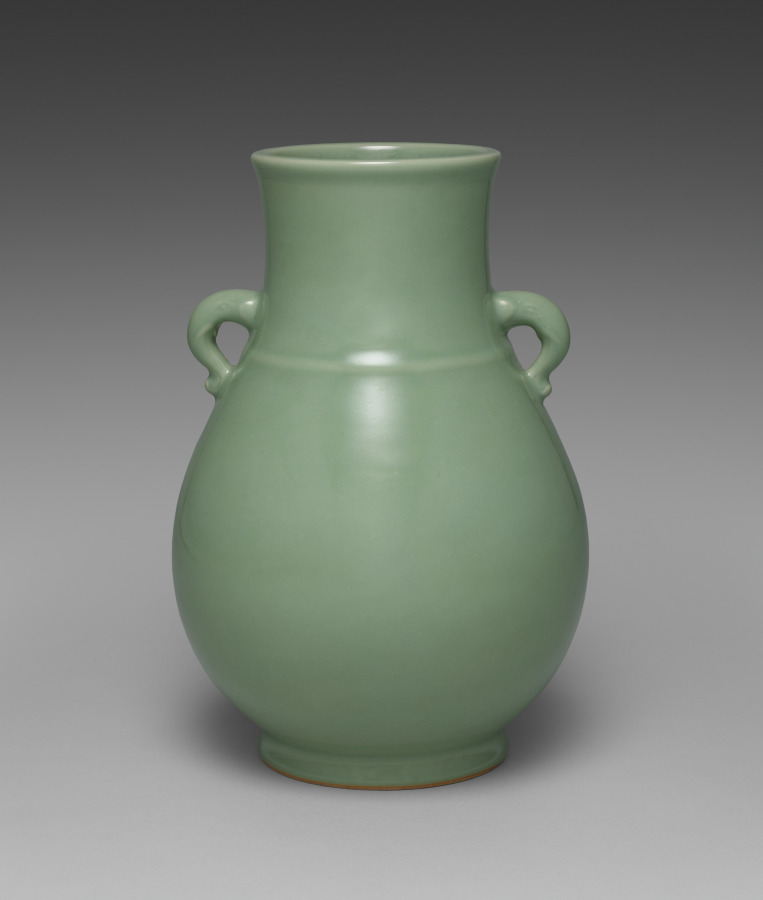
A celadon green vase with two handles on either side.
Generated by LinkedCulture from the photograph alone, without the museum’s catalogue text (Qwen/Qwen2.5-VL-7B-Instruct), and not yet reviewed by a person. It describes the picture, not the object’s history, and it is not part of the museum’s record.
From the Cleveland Museum of Art record
Many of the vases created by Yohei III and IV were made with reference to and in emulation of Chinese ceramics in both form and glazing. The Seifu studio was inspired by later Chinese copies of two other archaic vessel types, the hu (Japanese ko ) and guan (Japanese kan ). In simple terms, in their original contexts, the hu and guan were storage jars that also appeared in ritual contexts. This hu -form vase by Yohei IV has a green glaze and handles in the shape of an elephant head. The details of the elephant heads are quite easy to miss, but a close look reveals that each has carved eyes with pupils defined, tiny ears and tusks in very low relief, and a curved trunk with the end curled up. This sort of container is even known as the “elephant ear” type. The only other decorative element on the vase’s pear-shaped body is a raised cordlike band around the shoulders. The handles are shaped like elephant heads.
The authoritative record is held by Cleveland Museum of Art. LinkedCulture surfaces this object and its connections; it does not alter institutional metadata.
Get printable QR codesHide QR codes
Open QR codes for this object page and the museum record. They stay collapsed until needed.
Provenance & credit
As published by the source institution. Coverage varies — not every institution's open-data feed includes ownership history.
- Credit line
- Gift of James and Christine Heusinger
- Provenance
- ?–2022: James and Christine Heusinger, Berea, OH, given to the Cleveland Museum of Art | 2022–: The Cleveland Museum of Art, Cleveland, OH
Related across collections
Semantically similar works from Cleveland Museum of Art and other institutions.