Cleveland Museum of Art
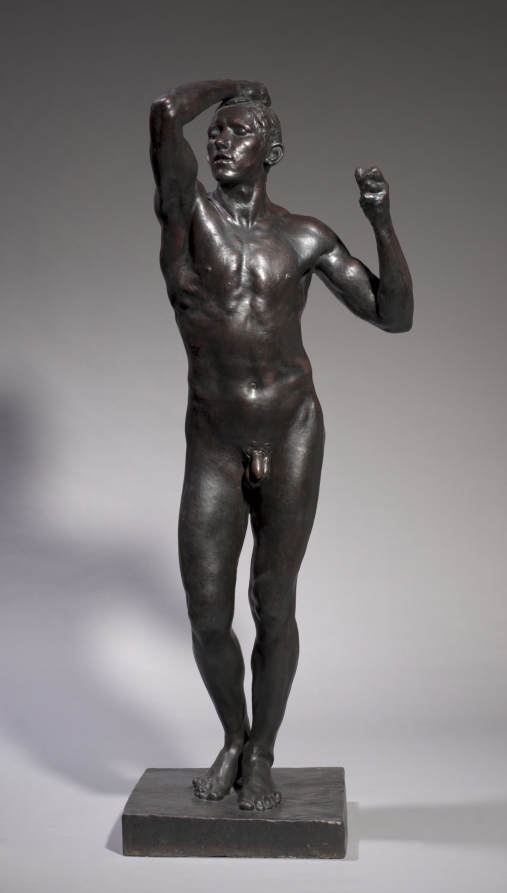
The Age of Bronze
Auguste RodinLinkedCulture matchlcp-330bd0e8de10
- Date
- 1875–76
- Medium
- bronze
- Culture
- France, 19th century
- Department
- Modern European Painting and Sculpture
- Institution
- Cleveland Museum of Art
- Object ID
- 98627
What the image shows
A bronze statue of a nude male figure standing with one arm raised and the other bent at the elbow.
Generated by LinkedCulture from the photograph alone, without the museum’s catalogue text (Qwen/Qwen2.5-VL-7B-Instruct), and not yet reviewed by a person. It describes the picture, not the object’s history, and it is not part of the museum’s record.
From the Cleveland Museum of Art record
Rodin’s earliest surviving life-size sculpture, The Age of Bronze is an enigmatic and provocative image of a man awakening to new consciousness. The figure originally held a spear in one hand; by removing the weapon, Rodin stripped the sculpture of narrative symbols and focused on the sensuality and psychological power of the male nude. Contemporaries found the figure so realistic they falsely accused Rodin of making a cast from a living person. Museum trustee Ralph King commissioned this cast from the artist in 1916 with the intention of donating it to the museum. Rodin personally supervised the exceptionally fine casting and finished it with his favorite patina, a deep reddish tone he called “crushed grape.” The sculpture suggests the heroism and suffering of his countrymen during the Franco-Prussian War of 1870–71. This life-sized male figure was modeled after a Belgium soldier named August Neyt.
The authoritative record is held by Cleveland Museum of Art. LinkedCulture surfaces this object and its connections; it does not alter institutional metadata.
Get printable QR codesHide QR codes
Open QR codes for this object page and the museum record. They stay collapsed until needed.
Provenance & credit
As published by the source institution. Coverage varies — not every institution's open-data feed includes ownership history.
- Credit line
- Gift of Mr. and Mrs. Ralph King
- Provenance
- 1918: Mr. and Mrs. Ralph King, Cleveland, Ohio, given to the Cleveland Museum of Art | 1918-: The Cleveland Museum of Art, Cleveland, OH
Related across collections
Semantically similar works from Cleveland Museum of Art and other institutions.