Art Institute of Chicago
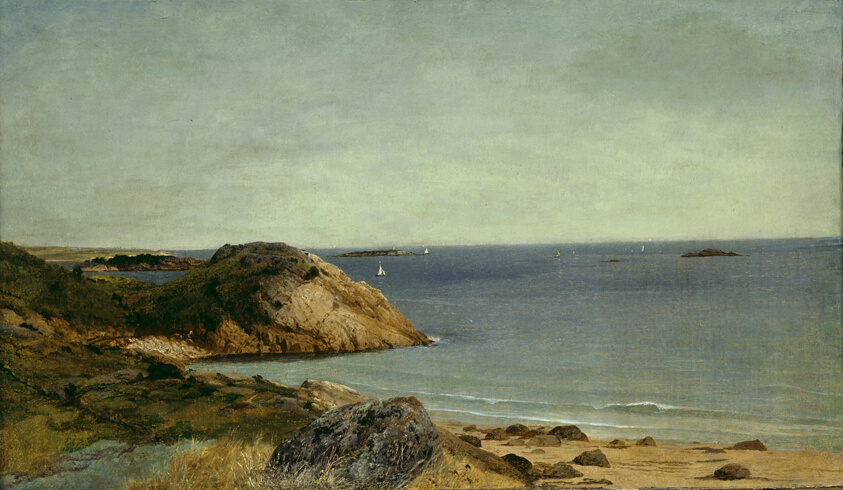
Rocky Coast
John Frederick Kensett (American, 1816–1872)LinkedCulture matchlcp-319c5daaa748
- Date
- c. 1860
- Medium
- Oil on canvas
- Culture
- United States
- Department
- Arts of the Americas
- Institution
- Art Institute of Chicago
- Object ID
- 145805
From the Art Institute of Chicago record
Like the Impressionists, who emphasized light effects, painters of the Hudson River School focused on temporal conditions of the landscape to suggest specific atmospheres. In Rocky Coast , John Frederick Kensett depicted the shoreline on a hazy day, with calm water and gentle waves. The careful treatment of nature by the Hudson River School artists has been linked to the writings of Transcendentalists such as Ralph Waldo Emerson, who wrote in Nature (1836): “Standing on the bare ground,—my head bathed by the blithe air, and uplifted into infinite space,—all mean egotism vanishes. I become a transparent eye-ball. I am nothing. I see all.” The horizon line of Rocky Coast illustrates this idea, as the uninterrupted water appears infinite, suggesting that the ocean continues beyond the vision of the viewer.
The authoritative record is held by Art Institute of Chicago. LinkedCulture surfaces this object and its connections; it does not alter institutional metadata.
Get printable QR codesHide QR codes
Open QR codes for this object page and the museum record. They stay collapsed until needed.
Provenance & credit
As published by the source institution. Coverage varies — not every institution's open-data feed includes ownership history.
- Credit line
- Gift of Brooks McCormick
Linked open data
Authority identifiers that link this record into the wider web of cultural data — stable references you can follow to the source.
- Object type
- AAT300033618
Part of LinkedCulture topics
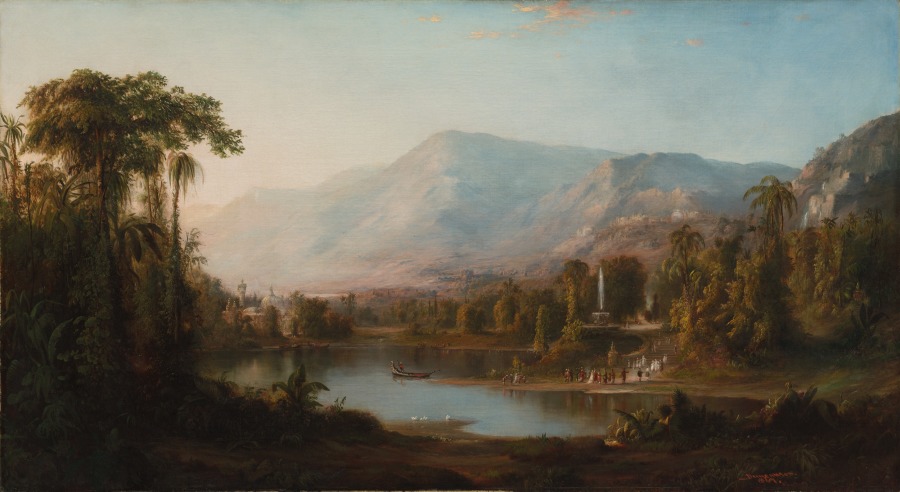 American Landscape and Coastal Paintings
These works are 19th-century oil paintings depicting natural landscapes and seascapes from the northeastern United States, particularly coastal New England regions and rocky shores.
140 objects from 4 institutions
 American Watercolor Landscape Art
These objects are predominantly watercolor and drawing works by American artists depicting natural landscapes, outdoor recreational activities, and coastal or wilderness scenes from the 19th century.
63 objects from 3 institutions
Related across collections
Semantically similar works from Art Institute of Chicago and other institutions.