Cleveland Museum of Art
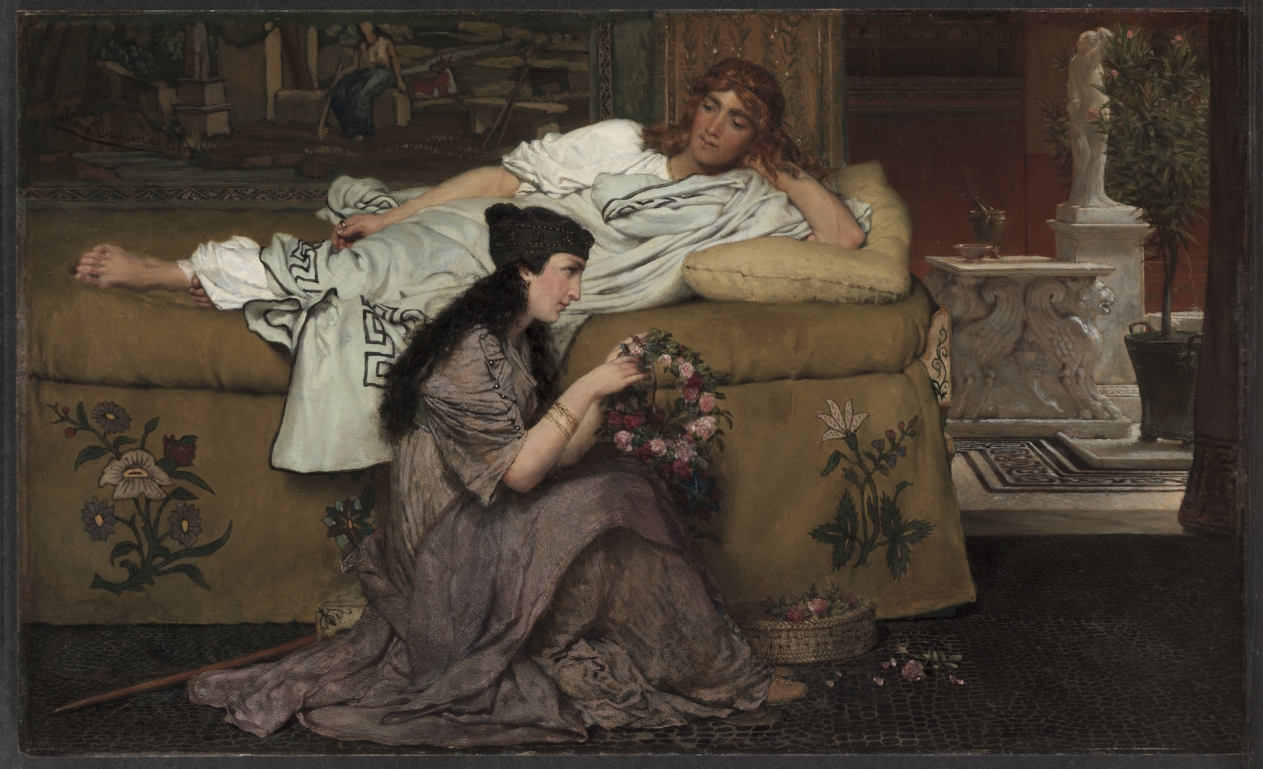
Glaucus and Nydia
Lawrence Alma-TademaLinkedCulture matchlcp-d752d2fadece
- Date
- 1867
- Medium
- oil on wood panel
- Culture
- England, 19th century
- Department
- Modern European Painting and Sculpture
- Institution
- Cleveland Museum of Art
- Object ID
- 148971
From the Cleveland Museum of Art record
"It was one of the few moments in her brief and troubled life that it was sweet to treasure." Weaving a rose garland as a present for her beloved master Glaucus, the blind servant Nydia resists speaking of her love for him. The scene is based on Sir Edward Bulwer-Lytton's enormously popular historical novel The Last Days of Pompeii (published in 1835), a melodramatic epic set in ancient Roman times, which culminates with the eruption of Mount Vesuvius. Responding to the 19th-century appetite for things antique, the artist filled his historical scenes with depictions of Roman frescoes and statuary. Dutch by birth, Alma-Tadema made this picture in Brussels for a London art dealer. But the demand for such paintings became so great that he moved to England, where he achieved great financial and social success. Alma-Tadema, one of the most popular Victorian painters, became famous for his depictions of the luxury and decadence of the Roman Empire. His vision of the ancient world was constantly reproduced on film in Hollywood.
The authoritative record is held by Cleveland Museum of Art. LinkedCulture surfaces this object and its connections; it does not alter institutional metadata.
Get printable QR codesHide QR codes
Open QR codes for this object page and the museum record. They stay collapsed until needed.
Provenance & credit
As published by the source institution. Coverage varies — not every institution's open-data feed includes ownership history.
- Credit line
- Gift of Mr. and Mrs. Noah L. Butkin
- Provenance
- 1867: Ernest Gambart, London, United Kingdom, by commission of the artist | 1867-1870: Ernest Gambart [1814-1902], London, United Kingdom, after 1870 sold to José de Murrieta, alias Marquis de Santurce. | 1883: (Christie's, London, United Kingdom, April 7, 1883, lot 164, Marquis de Santurce sale, bought in) | 1895: (Christie's, London, United Kingdom, March 30, 1895, lot 143, sold to Stephen Gooden & Fox) | 1895: ( Stephen Gooden & Fox, London. United Kingdom, sold to Thomas Agnew & Sons) | 1917: (Thomas Agnew & Son, London, United Kingdom, January 15, 1917 sold to A.G. O'Neil) | 1973: (Sotheby's Belgravia, Funt Collection Sale, November 6, 1973, lot 8, sold to Jules Brassner, New York. | Jules Brasser [1916-1999], New York, NY, sold to Mr. Noah Butkin | 1977: Mr. Noah Butkin [1918-1980],Cleveland, given to the Cleveland Museum of Art | 1977-: The Cleveland Museum of Art, Cleveland, OH
Related across collections
Semantically similar works from Cleveland Museum of Art and other institutions.